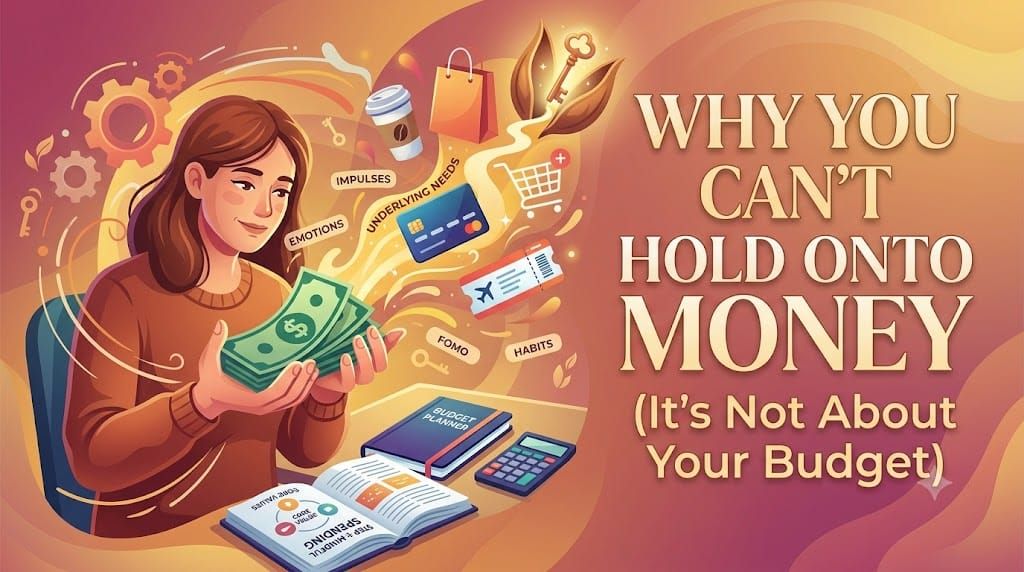
I earned more money last year than I ever had in my life. And I spent it faster than I ever have.
It was as if my bank account had a hole in it. Money would come in on Monday and be gone by Friday. Not on luxury items or reckless purchases — just... gone. Eating out when I didn't need to. Buying things I didn't care about. Subscribing to services I never used. Throwing bills at problems that didn't require money to solve.
I kept telling myself I needed a better budget. A better system. More discipline.
But the problem was never the budget.
The Feeling You Can't Name
When money landed in my account, I didn't feel happy. I felt a nagging sensation in my chest — like I didn't deserve it. Like the money was a mistake, a temporary visitor who would soon realize it had come to the wrong address.
So I would spend it. Not joyfully. Not carefully. Just... carelessly. As if getting rid of it quickly would relieve the discomfort of having it.
And it did — for about ten minutes. Then the guilt would arrive.
When I lost the money — whether through spending or through circumstances beyond my control — I felt something worse than guilt. I felt fear. Not the rational fear of "I need to pay rent." Something deeper. Something that felt like panic in my torso, a tightness that I couldn't explain.
It felt like being punished.
The Straight-A Student
To understand why I couldn't hold onto money, I had to go back to when I was a child.
Growing up, the adults in my life had a simple message: if you are good, you will be rewarded. Be a straight-A student, and you will get what you want. Behave well, and you will be loved.
It sounds reasonable on the surface. But underneath, it taught me something dangerous: that receiving good things required being good. That I had to earn the right to have. That my worthiness was conditional.
My inner child learned this lesson well. She believed that she needed to be good all the time — and that being her true self, with all her messiness and imperfection, would make her a bad child. A child who doesn't deserve rewards. A child who doesn't deserve to receive.
So when money came to me as an adult — without me having to "earn" it in the way I was taught — my inner child didn't know what to do. She felt like she was breaking the rules. She felt like a bad child receiving something she didn't deserve.
And what does a bad child do with something they don't deserve? They get rid of it. Quickly. Before anyone notices. Before anyone takes it back.
I Asked God
One night, sitting on my bedroom floor with my bank statement in front of me — the numbers not making sense because the math said I should have more but somehow I didn't — I did what I always do when I can't figure something out.
I asked God.
"God, there's something strange. When I started earning more money, I started spending it away more easily, as if I could hold the money one second and the next second, it's gone from my hands. Why?"
*"If you want to resolve this issue, I need to ask you: How do you feel when you spend money?"*
"Actually, when money comes into my account, I feel guilty and think I don't deserve that amount of money, so I end up getting rid of it as quickly as possible."
"That stems from a deep misunderstanding. When you were a child, did you ever feel unworthy of receiving good things?"
I sat with that question. And the answer came — not from my mind, but from somewhere deeper.
"If I think back, it was when I was very young. My parents had to work in Bangkok, and I had to stay in Khon Kaen with my sister and grandmother. Even though I expressed my desire for my parents to come back, they didn't."
"And how did that make you feel about yourself?"
"I felt that my needs had no value and that no one wanted to fulfill them. I felt that receiving what I wanted would make me a bad child."
"That's the core of the issue. You've always felt unworthy of good things, and when good things happen to you, it makes you feel like you're becoming a bad person, right?"
"Actually, it's deeper than that. I actually hate myself when I receive good things."
"The word 'hate' is very strong, but since it's your truth, let's work with it. So, do you really hate yourself? I mean, deep down, do you hate yourself and not want yourself to receive good things?"
"Hm... Actually, that's not quite it. I'm quite good at finding ways to make myself comfortable and happy. Does that count as loving myself?"
"Starting with tangible things, it's good enough. So, when do you feel the best about yourself?"
"When I do something for others, like working on something for them or buying something for them."
"And what about when you're just being still, not doing anything or being anything?"
"Honestly, I don't like myself much in those moments. I feel like I'm useless."
"Good. Now let's work on this further. Can you feel valuable even when you don't do anything or be anything?"
"This question makes me uncomfortable. If I'm honest... no. I don't feel good about myself if I'm not doing or being anything."
"That's very much to the point. This feeling is what makes you hate yourself when you receive good things. You feel that merely being yourself, without making sacrifices, doesn't make you valuable enough. You started to misunderstand that you always need to give up everything in order to be worthy."
I sat there, on the bedroom floor, and something clicked.
"Oh... to put it this way makes so much sense. That's why I need to 'sacrifice money' all the time and can't keep the money that should be mine for long, right?"
"Exactly. And if you want to resolve this issue, you need to correct your misunderstanding about sacrifice. You don't need to give, do, or be anything for anyone to feel valuable. You can just 'be' in your own energy, and that alone is enough to make you a beautiful and perfect soul. Do you understand me?"
I didn't fully understand it that night. But I remembered it. And over time, I began to live it.
This conversation is from Talking Money with God, a book I wrote for myself — and translated for anyone who needs to hear what I needed to hear.
The Punishment
When the money was gone, the panic would arrive. And that panic — I realize now — wasn't about money at all.
It was the feeling of a child who has been caught being bad. The feeling of waiting to be punished.
Every time my bank balance dropped, my body reacted not like an adult managing finances, but like a child who had done something wrong and was about to be found out.
The tightness in my torso. The regret that I couldn't control. The helplessness. None of it was about the money. It was about a belief I had carried since childhood: I am not enough, and if I receive something good, I will lose it because I don't deserve it.
The Real Work
No budget could fix this. No app could track it away. No amount of financial discipline could solve a problem that wasn't financial.
The real work was healing the child inside me who believed she had to earn the right to receive.
I started by talking to her. Not in a formal meditation practice — though I do meditate — but in small, quiet moments. When money came in, I would pause and say to her: You are enough. You don't have to be good to receive this. You don't have to be perfect. You just have to be here.
When I spent money, I would check in: Am I spending this from joy or from guilt? Am I buying this because I want it, or because I need to get rid of the discomfort of having money?
Slowly, gradually, the feelings shifted.
The nagging sensation faded. The panic when money left softened. The tightness in my torso loosened. Not because I forced it, but because the child inside me finally heard what she needed to hear: You are already enough.
What Changed
I won't pretend everything is perfect. I still have moments where I catch myself spending carelessly. But now I notice. And when I notice, I pause. I breathe. I tell the child inside me that it's okay to have. It's okay to keep. It's okay to receive without earning.
And something else happened that I didn't expect.
When I stopped panicking about money, money started coming more easily. Not because I manifested it or used a special technique — but because when you stop gripping, things flow. When you stop pushing money away, it stops running from you.
I now trust that there are many ways money can come to me. It doesn't have to be one source, one job, one strategy. It can come from anywhere — a new client, an unexpected opportunity, a conversation that turns into something. I don't need to control the channel. I just need to stay open.
And it works.
I don't feel panic anymore. I feel something I never thought I'd feel about money: relief.
One Word
If I could give you one word to take from this article, it would be this:
Enough.
You are already enough to receive. You don't have to earn it. You don't have to be good. You don't have to be perfect. You don't have to prove anything to anyone — not even to yourself.
The reason you can't hold onto money might not be about your budget at all. It might be about a child inside you who was told they had to earn the right to have good things.
Tell that child what they need to hear.
And then watch what happens.
If this resonated with you, I'd love to hear your story. What's your relationship with receiving? Share in the comments — I read every one.